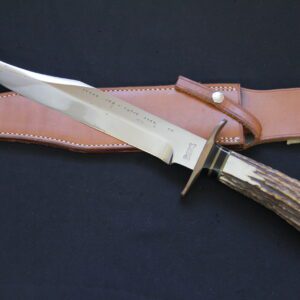
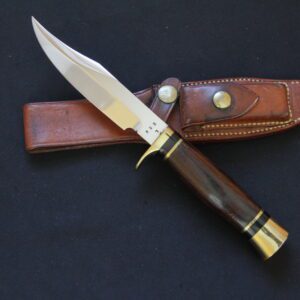
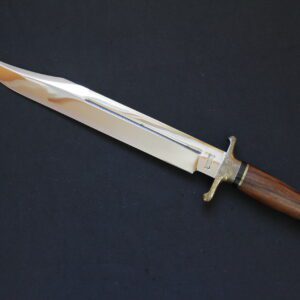
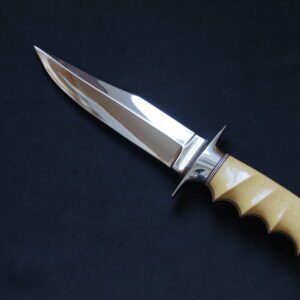
What an “Integral Blade” Means in General
An integral blade (also called a full integral or integral bolster/guard) is a knife forged from a single, solid piece of steel.
In a standard knife, the blade, the guard (the metal piece that protects your hand), and the tang (the part of the steel that goes into the handle) are often made as separate components. A pre-made guard is slid over the tang and then soldered, pinned, or press-fit into place.
In an integral knife, there are no separate parts. The blade, the bolster, and/or the guard are all one continuous piece of steel with the tang.
Key Characteristics of an Integral Blade:
-
Seamless Flow: There are no visible joints, seams, or solder lines between the blade and the bolster/guard. It looks and feels like it was sculpted from a single block.
-
Exceptional Strength: Because there are no joints, there are no potential points of failure. It is structurally the strongest way to build a fixed-blade knife.
-
Difficult to Make: This is the most important point. Creating an integral is a supreme test of a bladesmith’s skill for several reasons:
-
Forging Skill: The smith must start with a much larger bar of steel and painstakingly “upset” and forge the material to create the wider, thicker area for the guard/bolster, all while keeping the blade and tang dimensions correct. This requires incredible hammer control.
-
Material Waste: A significant amount of the initial steel bar is ground away to achieve the final shape, making it a costly process.
-
Grinding Precision: Grinding the complex curves and transitions of an integral, especially the area where the blade meets the guard, without errors is immensely difficult. One slip can ruin the entire piece.
-
Think of it like this: It’s the difference between building a statue by gluing separate arms and a head onto a torso, versus carving the entire statue, arms and all, from a single block of marble. The latter requires far more skill and vision.